
Entrance automation · 5 min read ·
Boom barrier price in Kerala (2026): cost, access options & sizing
What a boom barrier costs to install in Kerala, how to size the arm for your entry, which access method suits your traffic, and why duty cycle matters more than price on a busy gate.
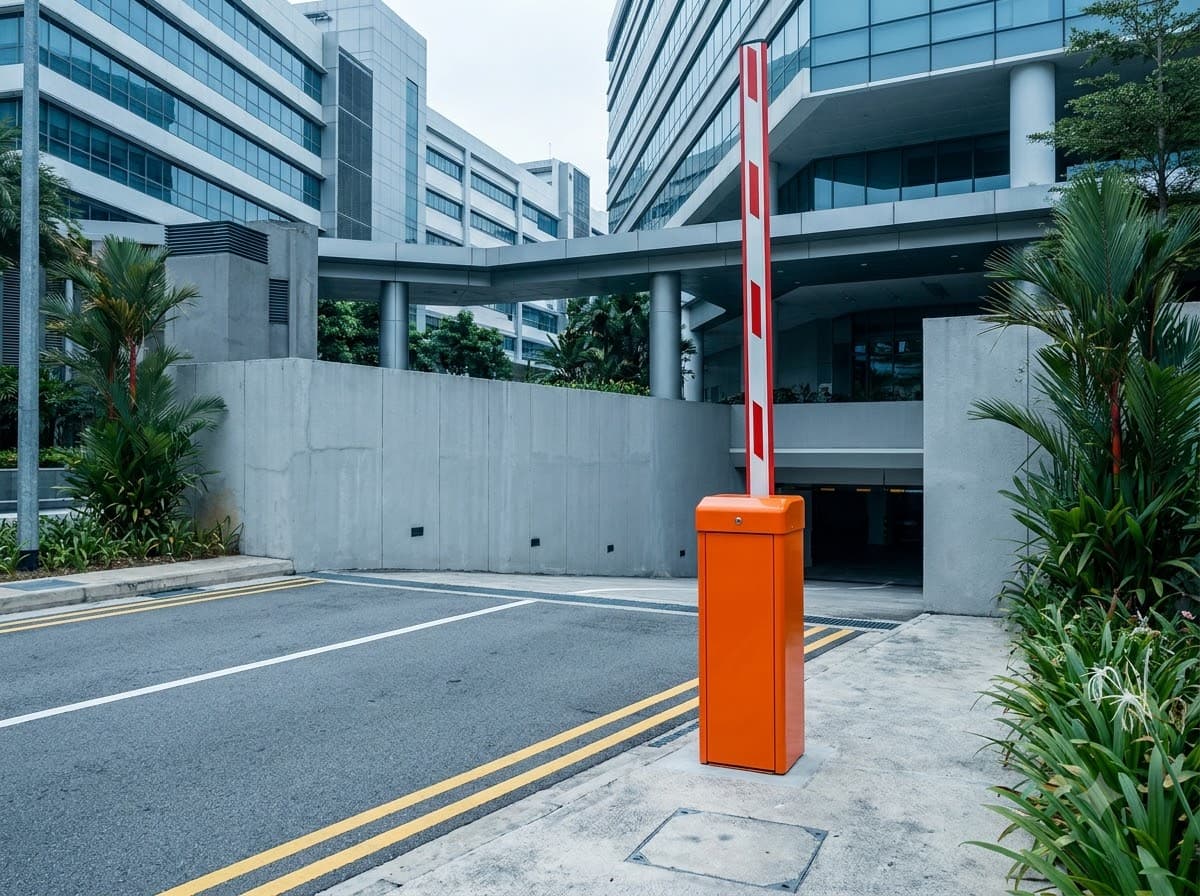
A boom barrier is a different tool from an automatic gate. It isn't there to secure a boundary — it's there to control vehicles, quickly, hundreds of times a day. Price it on that basis and the decisions get clearer.
Starting price
From ₹60,000, including GST.
That includes what we fit as standard on every entrance automation job:
- Safety sensors (photocells) — so the arm never comes down on a vehicle
- Battery backup — operation continues through a power cut
- 2 remote controls — extra remotes available, and RFID tags/cards as an add-on
- Installation, wiring and configuration
- A free site survey first
An AMC is available separately, and on a barrier it matters more than on a home gate — see duty cycle below.
Sizing the arm
Measure the clear width of the lane the barrier has to close. That's the span the arm must cover, and it drives the hardware choice:
- A single car lane is commonly around 3 metres.
- Wider commercial entries, two-lane entries, or anything taking trucks need a longer arm.
Arm length isn't a trivial variable. A longer arm is a longer lever, so it loads the mechanism more and needs a motor specified accordingly. Fitting an over-long arm to an under-specified unit is a reliable way to wear out the gearbox.
One practical note: where the lane is wide but you don't want a very long arm, it's often better to narrow the lane with a kerb or island than to oversize the barrier.
Duty cycle is the real specification
This is where boom barriers differ most from residential gates, and where cheap quotes come apart.
A home gate might open six times a day. An apartment entry can run 300–600 cycles a day. A commercial yard or a paid parking entrance can run more. Over a year, that's the difference between a few thousand operations and a quarter of a million.
Motors are rated for this. A unit specified for intermittent residential use, installed on an apartment entrance, won't last — and the failure won't be covered by anything, because it was the wrong specification from the start. When you compare barrier quotes, the rated cycles-per-hour figure matters more than the price.
Choosing the access method
| Users | Usually best |
|---|---|
| A household or a small fixed group | The two remotes that come with the barrier |
| More drivers than that | Extra remotes, or RFID tags as an add-on |
| Residents and staff with turnover | RFID tags — revoked one at a time when somebody leaves |
| Visitors | A guard on the gate, or an intercom if you add one |
Remotes are anonymous: the barrier knows a valid signal arrived, not who sent it. If one goes missing the fix is re-pairing the receiver, which means re-pairing the others too. RFID is the answer where users change — a tag is tied to a vehicle and revoked on its own, so one loss doesn't disturb everybody. That is what the add-on buys you.
What moves the quote
- Arm length and the matching motor specification.
- Duty cycle — how many vehicles per day, which sets the class of unit.
- Access add-ons — extra remotes, or RFID readers with tags or cards.
- Civil work — barriers usually need a concrete base, and that may not exist yet.
- Cable runs — distance to power, and whether cable can go in conduit or needs trenching. On a parking entrance this often crosses a driveway, which is real work.
- Loop detectors or additional safety — ground loops to detect a waiting or departing vehicle, where traffic justifies it.
Where barriers get installed badly
Three recurring problems, all avoidable at the survey stage:
- No safety sensor, or one aimed badly. The arm has to detect a vehicle underneath it. Alignment is not optional, and it needs re-checking over time.
- The barrier sited too close to the road. A vehicle waiting for the arm then blocks traffic. Set it back far enough for one vehicle to clear the road while waiting.
- No thought about exit. An entry barrier with no exit plan creates a queue at the wrong end. Decide early whether one barrier serves both directions or you need two.
Barrier, gate, or both
If you're weighing this against gate automation, the split is simple: a barrier manages vehicle flow, a gate secures a boundary. A barrier stops cars, not people — it's a traffic device, not a security device.
Plenty of sites want both: the gate closed overnight for the perimeter, the barrier handling vehicles during the day. If the boundary is your actual concern, start with automatic gate pricing instead.
The bottom line
Budget from ₹60,000 including GST for the barrier, arm, DC motor, 2 remotes and sensors, then add installation after the free survey. Specify the duty cycle honestly — a barrier is the one piece of entrance hardware where buying for the traffic you actually have, rather than the price you hoped for, decides whether it's still working next year.
See our boom barrier installation service, or WhatsApp us your lane width and roughly how many vehicles pass a day, and we'll come back with a realistic figure and a free site survey. We install across Kottayam, Ernakulam, Pathanamthitta and Alappuzha.
Frequently asked
Common questions on this topic.
Keep reading
More from the ITSolute blog.
Automatic gate price in Kerala (2026): sliding, swing & roller
What automatic gate installation actually costs in Kerala — real starting prices for sliding, swing and roller gate automation, what's included as standard, and the seven things that move the final quote.
Apartment gate automation: what shared entrances need
A gate serving thirty flats is a different machine from a gate serving one house. Duty cycle, revocable access, visitor handling and who pays for maintenance — what to specify for a shared entrance in Kerala.
RFID vs remote vs voice: gate access options explained
Two remotes come with every gate. RFID tags are an add-on, voice control needs a DC motor, and every motor has a manual release key. Here's what each one is good for, and which matters on a home versus a block of flats.