
Entrance automation · 6 min read ·
Sliding vs swing gates in Kerala: which should you automate?
The choice comes down to the space you have, your slope, and how your driveway meets the road — not preference. A practical comparison for Kerala homes, with costs and the monsoon factor.
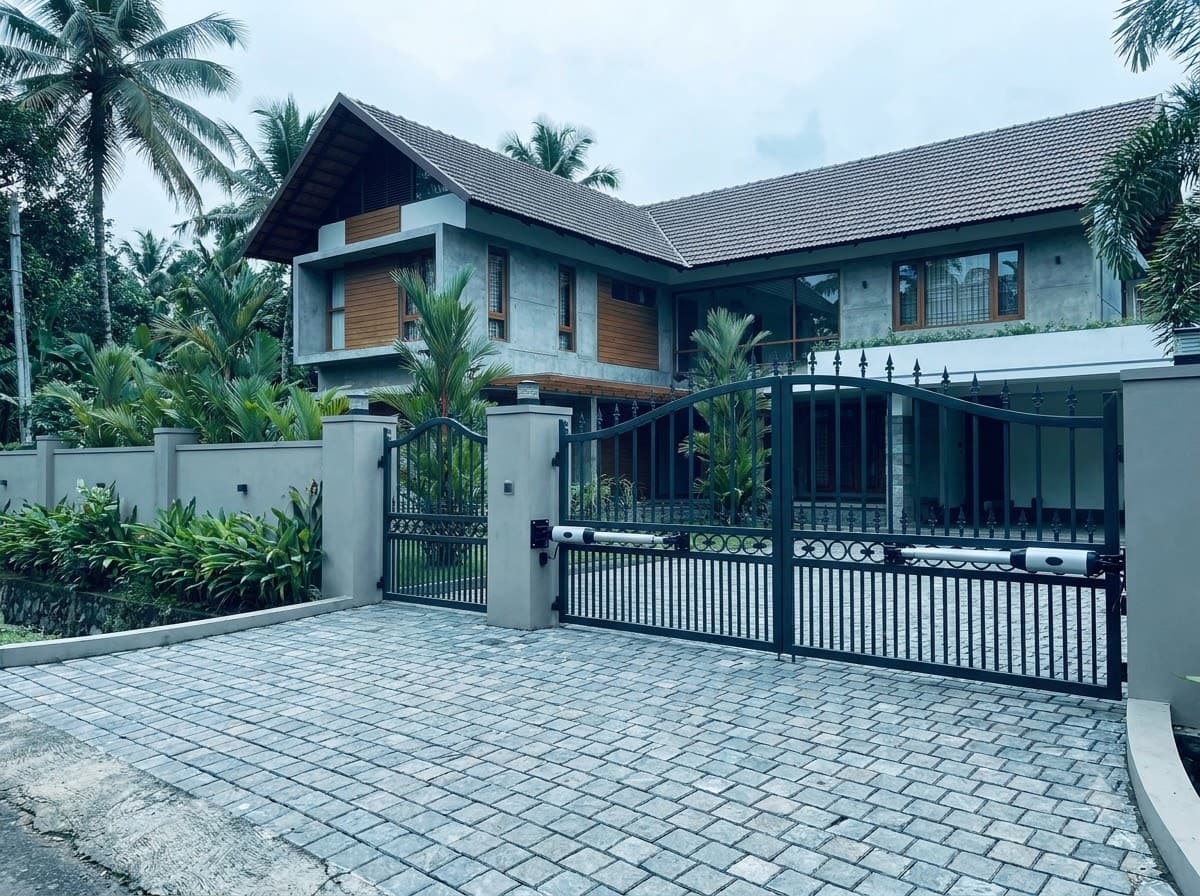
Most people arrive at this question with a preference already. In practice, your plot usually decides it for you — and the deciding factor is almost never which type you like better.
Here's how to work out which one your site actually allows.
The one measurement that settles most cases
Stand at your gate and look for two things:
- Clear run alongside the gate line, inside the compound — enough to take the full width of the gate as it slides open. A 4-metre gate needs roughly 4 metres of clear wall or fence to park against, plus a little.
- Clear arc inside the gate line — enough for the leaf, or both leaves, to swing through 90° without hitting a car, a step, a planter, or the slope.
If you have the run but not the arc, you're sliding. If you have the arc but not the run, you're swinging. Plenty of Kerala plots, especially narrow urban ones in Kottayam town or along the Ernakulam corridor, have neither in abundance — and then the answer comes down to which constraint is cheaper to fix.
Where your driveway meets the road
This is the factor people forget, and it matters most on short driveways.
A swing gate opening inward sweeps across the first two or three metres of your driveway. If your driveway is short, that arc lands exactly where a car has to stand while the gate opens — so the car has to wait on the road. On a busy road, that's a genuine problem, not an inconvenience.
A sliding gate never enters the driveway. The vehicle can be fully off the road, waiting, while the gate opens across the boundary. On a short driveway meeting a busy road, this alone usually decides it.
Gates that open outward over a public footpath are not a solution — they put the leaf across a pavement where people walk.
Slope
Kerala has a lot of sloping plots, and slope is harder on swing gates than most people expect.
A swing leaf travels in a fixed horizontal plane. On a driveway that rises inward, the leaf will foul the ground as it opens. The workarounds are both compromises: hang the gate high enough to clear the slope and live with a large gap underneath, or re-level the driveway.
A sliding gate runs on a level track laid across the slope. The gate itself stays level; the ground does what it likes. This is why so many sloped sites end up sliding even when the owner wanted swing.
Cost
All prices include GST and cover the motor kit:
| Option | Motor | From |
|---|---|---|
| Sliding gate | Standard (AC) | ₹34,000 |
| Sliding gate | Premium (DC) | ₹39,500 |
| Swing gate — single arm | DC | ₹40,000 |
| Swing gate — double arm | DC | ₹44,000 |
Sliding automation starts lower, and a double-leaf swing gate is the most expensive of the three because it needs two motors working in sync.
But read that table with a caveat: if you don't have the side run and need to build a track foundation and clear the wall line, the civil work can close the gap. The automation is cheaper; the preparation may not be. Our full price breakdown covers what moves the final figure.
The monsoon factor
Both types survive a Kerala monsoon when installed properly. They fail differently, and knowing how changes what you ask for.
Sliding gates fail at the track. Silt, leaf litter and sand wash into the channel; the rollers start labouring; the motor works harder against the resistance and eventually the force limit trips or the gearbox wears. The fix is designed in, not bolted on: a track with drainage so water leaves instead of pooling, and clearing the channel as routine maintenance.
Swing gates fail at the hinges and posts. Standing water at the post base and constant wet-dry cycling attack the pivot points. A swing gate with seized hinges will fight the motor exactly the way a silted track does.
Near the coast — Alappuzha, and the backwater belt generally — salt air accelerates all of this on either type, and the honest answer is that maintenance intervals get shorter, whichever you choose.
Quick decision table
| Your situation | Likely answer |
|---|---|
| Short driveway onto a busy road | Sliding |
| Driveway rises inward | Sliding |
| Clear wall alongside the gate | Sliding |
| Wide frontage, generous forecourt | Either — pick on looks and cost |
| No side run, but plenty of room inside | Swing |
| Existing sound gate of one type | Automate that type |
Roller gates, briefly
There's a third option, and its name causes confusion — a roller gate is not a rolling shutter. It's a swing gate driven by wheel motors mounted at the bottom of each leaf, which roll along the ground as the gate opens.
That matters on a plot with no room alongside for a sliding gate to park, where the ground is sound enough for a wheel to run on but the posts or hinges wouldn't carry the load of a conventional swing arm. Roller gate automation starts from ₹46,000 including GST, on a DC motor.
What we'd tell you at the survey
If you already have a sound gate, automate what you have. Changing type means a new gate, a new foundation and usually new posts — that's fabrication, not automation, and it rarely pays unless the existing gate is failing anyway. Automating an existing gate covers what makes a gate suitable.
If you're building from scratch and the plot genuinely allows either, sliding is the lower-maintenance choice on a slope or a tight frontage, and swing is the better-looking choice on a wide one.
Either way the standard fit is the same: the motor kit, 2 remotes and a safety sensor pair, with a free site survey first. RFID access and DC battery backup are add-ons.
See our automatic gate installation service, or WhatsApp us a photo of your gate and driveway — that's usually enough for us to tell you which way your site points before we visit. We cover Kottayam, Ernakulam, Pathanamthitta and Alappuzha.
Frequently asked
Common questions on this topic.
Keep reading
More from the ITSolute blog.
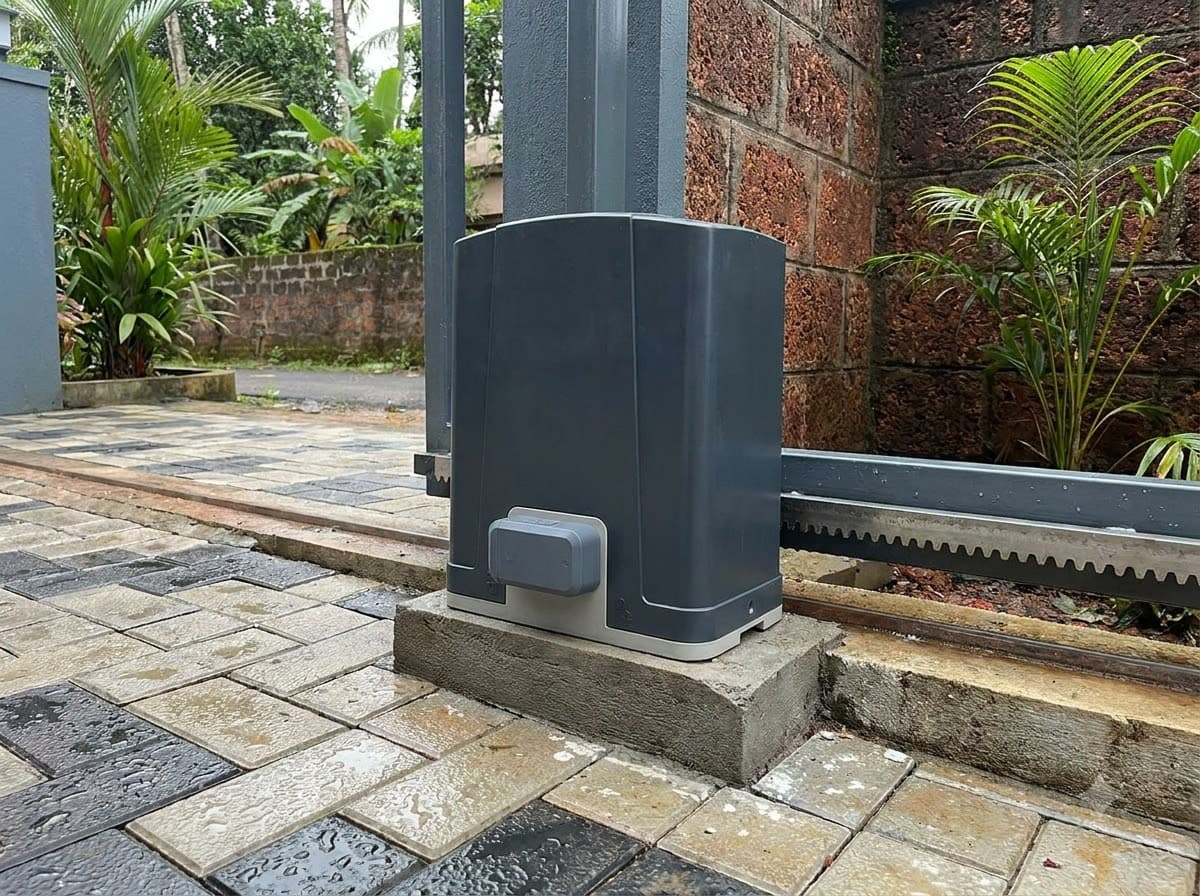
Automatic gate price in Kerala (2026): sliding, swing & roller
What automatic gate installation actually costs in Kerala — real starting prices for sliding, swing and roller gate automation, what's included as standard, and the seven things that move the final quote.
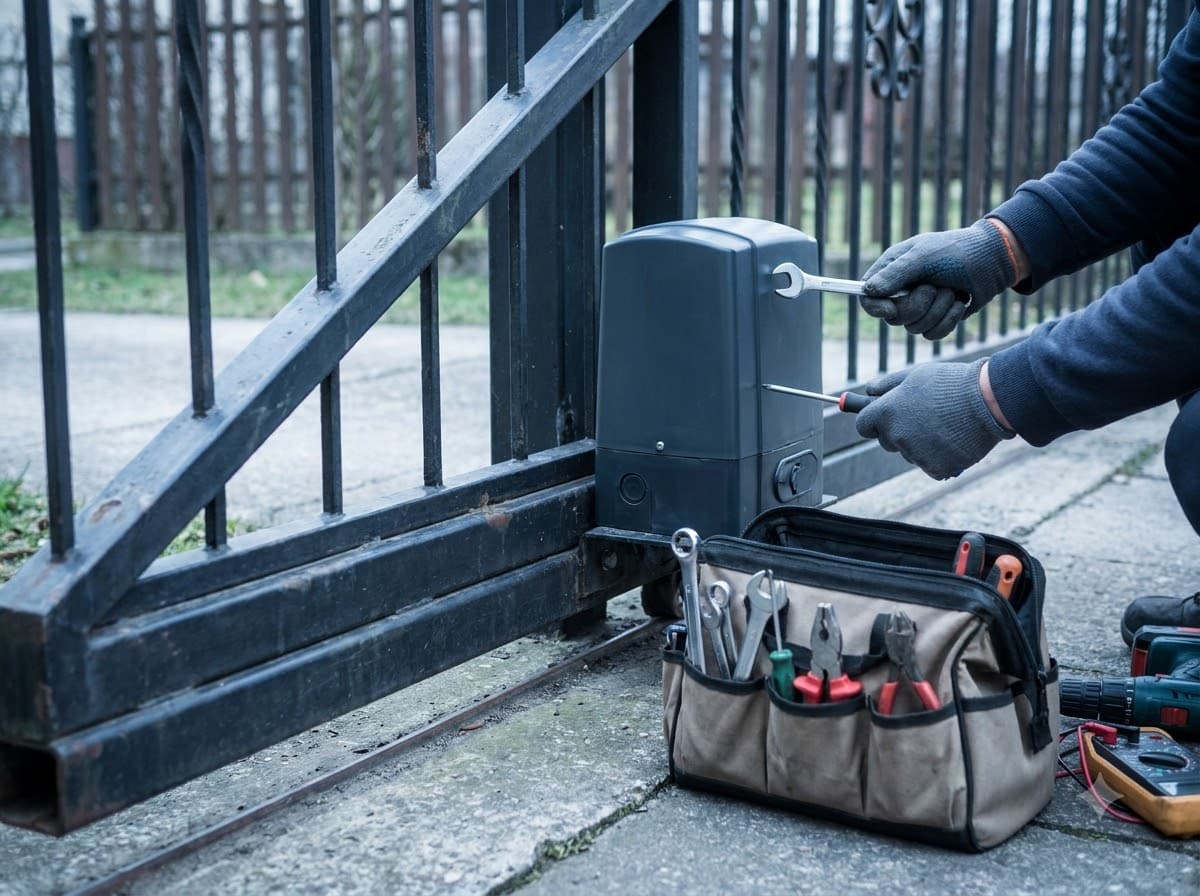
Can you automate an existing gate? A retrofit checklist
You usually don't need a new gate. Here's how to tell whether the gate you already have can be automated, what has to be fixed first, and what it costs to retrofit in Kerala.
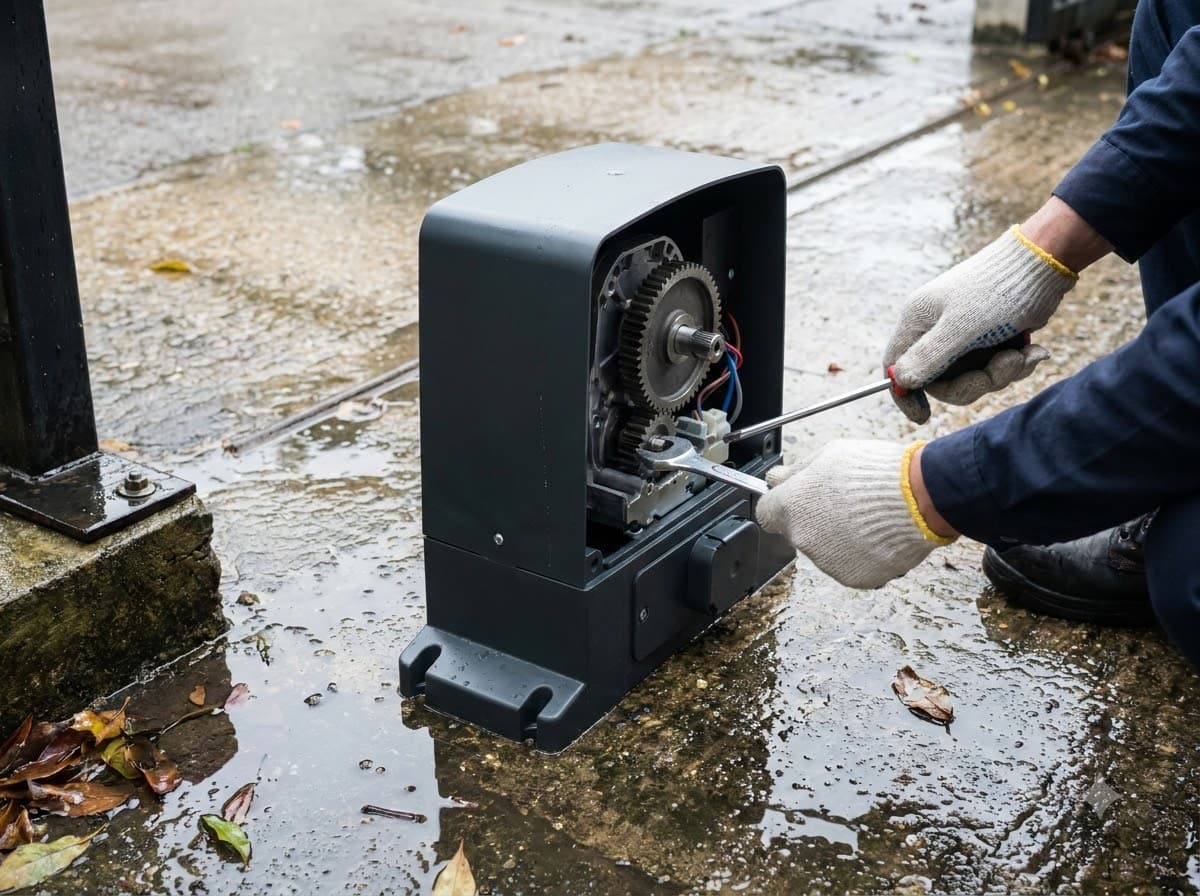
Automatic gate maintenance in Kerala: monsoon, salt air & AMC
Kerala is hard on gate automation — monsoon silt, standing water and coastal salt air all shorten its life. What maintenance actually involves, what you can do yourself, and what an AMC covers.